
How to Solve Bar Model Method Math: A Step-by-Step Parent's Guide
Master the Singapore Math Bar Model Method. Learn step-by-step how to solve part-whole, comparison, and before-after models for PSLE word problems with clear visual examples.
The Educator's Insight
"The Bar Model Method is not about finding the answer—it is about drawing the relationship. Once a child visualizes the 'units', the mathematics becomes simple subtraction or division. Focus on drawing first, calculations second."
Mrs. Heng
Senior Math Educator (MOE Alumna)
The Secret Behind Singapore Math: The Bar Model Method
If your child is in Primary 3 to 6, you've likely seen them stare blankly at a complex, multi-step math word problem.
In traditional mathematics, we try to solve these using abstract algebra (e.g., let $x$ be the number of apples...). But at the primary school level, algebra is too abstract.
This is why Singapore introduced the Bar Model Method (or Model Drawing). It is a visual language that bridges the gap between concrete objects and abstract algebraic equations.
This guide will teach you exactly how to solve model method math step-by-step, covering the three core model types your child must master for PSLE success.
1. The Part-Whole Model
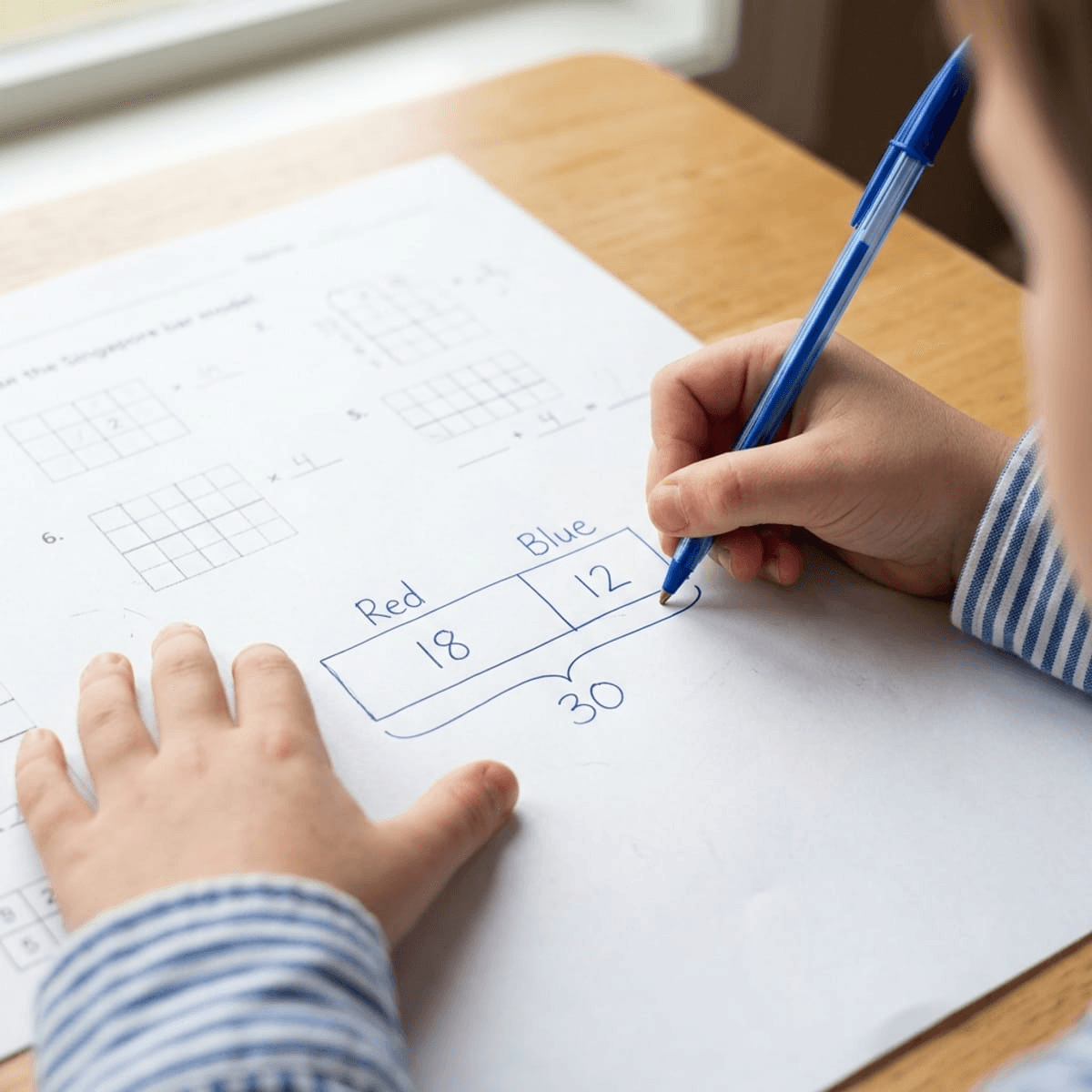
The Part-Whole model is the foundation. It shows the relationship between a whole quantity and its individual parts.
When to Use:
Use this when you are given the total (the "Whole") and need to find a missing part, or vice-versa.
Typical Word Problem:
Jane has some red and blue marbles. She has 120 marbles in total. If 80 of them are red, how many blue marbles does she have?
Interactive Part-Whole Model
The single unified bar represents the total of 120 marbles, divided proportionally into 80 red marbles and 40 blue marbles.
Source: ReLURN | The Pedagogy-First Learning Platform | www.relurn.com
Step-by-Step Walkthrough:
- ▸
Draw a single long rectangular bar representing the total (120 marbles).
- ▸
Partition the bar into two blocks. One block represents "Red" (80) and the other represents "Blue" (?).
- ▸
Label the total bracket at the top or bottom as 120.
- ▸
The visual representation immediately shows the math required:
Whole − Part = Remaining Part
120 − 80 = 40
- ▸
Answer: Jane has 40 blue marbles.
2. The Comparison Model
This is the most frequently tested model type in lower and upper primary. It compares two or more different quantities.
When to Use:
Look for comparison keywords: more than, less than, fewer than, times as many as, twice as much.
Typical Word Problem:
Alan has $45 more than Bob. Together, they have $115. How much money does Bob have?
Interactive Bar Model
Alan's bar is longer than Bob's by exactly $45 difference. Together, they equal $115.
Source: ReLURN | The Pedagogy-First Learning Platform | www.relurn.com
Step-by-Step Walkthrough:
- ▸Draw two separate bars stacked vertically—one for Alan, one for Bob.
- ▸Since Alan has more, make his bar longer.
- ▸Draw a dotted line to show the equal part, and label the extra extended block of Alan's bar as $45.
- ▸Draw a curly bracket grouping both bars together and label the total as $115.
- ▸How to Solve:
- ▸
Looking at the model, if we cut off Alan's extra $45, both bars will be equal to Bob's bar (represented as 2 equal units).
- ▸
Step 1: Subtract the difference from the total:
115 − 45 = 70 (this represents 2 equal units)
- ▸
Step 2: Divide by 2 to find 1 unit (Bob's share):
70 ÷ 2 = 35
- ▸
- ▸Answer: Bob has $35.
3. The Before-After Model (The Ultimate PSLE Hack)
As students progress to Primary 5 and 6, comparison models evolve into "Before-After" scenarios, where quantities change because items are bought, sold, or transferred.
When to Use:
Use this when a change occurs (e.g., gives away, spends, adds more) and a final ratio, fraction, or comparison is given.
Typical Word Problem:
Cody and Dan had an equal number of stamps. After Cody gave Dan 30 stamps, Dan had 3 times as many stamps as Cody. How many stamps did each have at first?
Step-by-Step Walkthrough:
This is where algebra gets messy, but bar models make it crystal clear.
Step 1: Analyze the "After" State
Draw the bars representing the final scenario first, because we know the ratio is 1:3.
- ▸Cody's Bar: Draw 1 small box (1 unit).
- ▸Dan's Bar: Draw 3 identical small boxes (3 units).
Interactive Bar Model
In the final state, Dan has exactly 3 times as many stamps as Cody (90 stamps vs 30 stamps).
Source: ReLURN | The Pedagogy-First Learning Platform | www.relurn.com
Step 2: Track the "Change"
- ▸Dan has 3 units because he received 30 stamps from Cody.
- ▸Cody has 1 unit because he gave 30 stamps to Dan.
- ▸If we look at their initial state (when they were equal), they must have been exactly halfway between Cody's 1 unit and Dan's 3 units.
- ▸Halfway between 1 unit and 3 units is 2 units.
- ▸This means:
- ▸Cody started with 2 units (he gave 1 unit, leaving him with 1).
- ▸Dan started with 2 units (he received 1 unit, giving him 3).
- ▸Therefore, the 1 unit transferred is exactly equal to 30 stamps.
Step 3: Calculate the Starting Amount
- ▸
Each started with 2 units:
2 × 30 = 60
- ▸
Answer: Cody and Dan each had 60 stamps at first.
Model Method vs. Algebra: When to Switch?
A common struggle as students move into Secondary school is letting go of the model method and adopting algebra.
| Feature | Bar Model Method (Primary) | Algebra (Secondary) |
|---|---|---|
| Cognitive Style | Pictorial, spatial, concrete | Abstract, symbolic, analytical |
| Best For | Visualizing fractions, ratios, shares | Complex multi-variable equations, rates |
| Speed | Faster for visualizing simple relationships | Faster for complex manipulations |
The Verdict:
At the Primary level, stick to the Bar Model Method. It prevents calculation errors because the child can physically see if their answers are logical. For instance, in the Cody & Dan problem, the child can physically see that Cody's block is smaller than Dan's.
Three Tips for Parents Helping with Bar Models
- ▸Draw First, Calculate Second: Do not let your child write any numbers or equations until the model drawing is fully completed and labeled.
- ▸Use Grid Paper: Drawing neat, proportional boxes is crucial. If 1 unit is drawn the same size as 3 units, the visual logic breaks down.
- ▸Encourage "Socratic" Questions: Instead of drawing the model for them, ask:
- ▸"Who has more? Should their bar be longer or shorter?"
- ▸"Do we know the total? Where should we bracket it?"
- ▸"What changed? Did the total amount of items change, or just who holds them?"
Supporting Bar Model Practice at Home
Three practical tips for parents:
- ▸
Draw on grid paper. The visual logic of bar models depends on proportional sizing. If one unit is drawn as three boxes and another as one box, the relationship is clear. Grid paper helps maintain proportions.
- ▸
Ask Socratic questions instead of giving answers. When your child is stuck, guide with questions:
- ▸"Who has more? How do we show that in the bar?"
- ▸"Do we know the total? Where does the bracket go?"
- ▸"What changed? Did the total change, or just who holds what?"
- ▸
Let them struggle a little. It is tempting to jump in and draw the model correctly. But the child learns more by drawing a wrong model, realising it does not fit, and trying again. The struggle is where the learning happens.
For additional practice, assessment books from Singapore's major publishers contain graded bar model exercises. Start with the level below your child's current grade to build confidence, then move up.
Related guides: PSLE Math Hard Questions: How to Master Them → | The Complete Model Method Guide → | PSLE Paper 2 Ratio & Fraction Models →
Loading comments...
Practice & Tools
Share this article