
The Singapore Math Model Method: A Complete Guide to Visual Problem-Solving
Understand the full Model Method—Singapore Math's visual problem-solving framework. Learn bar models, branching, stacking, and how to choose the right model for any word problem.
The Educator's Insight
"The Model Method is not a single drawing technique. It is a visual reasoning framework that evolves with the child—from simple bars in P3 to branching models and stacked units in P6. The right model makes the answer obvious."
Mrs. Heng
Senior Math Educator (MOE Alumna)
What Is the Singapore Math Model Method?
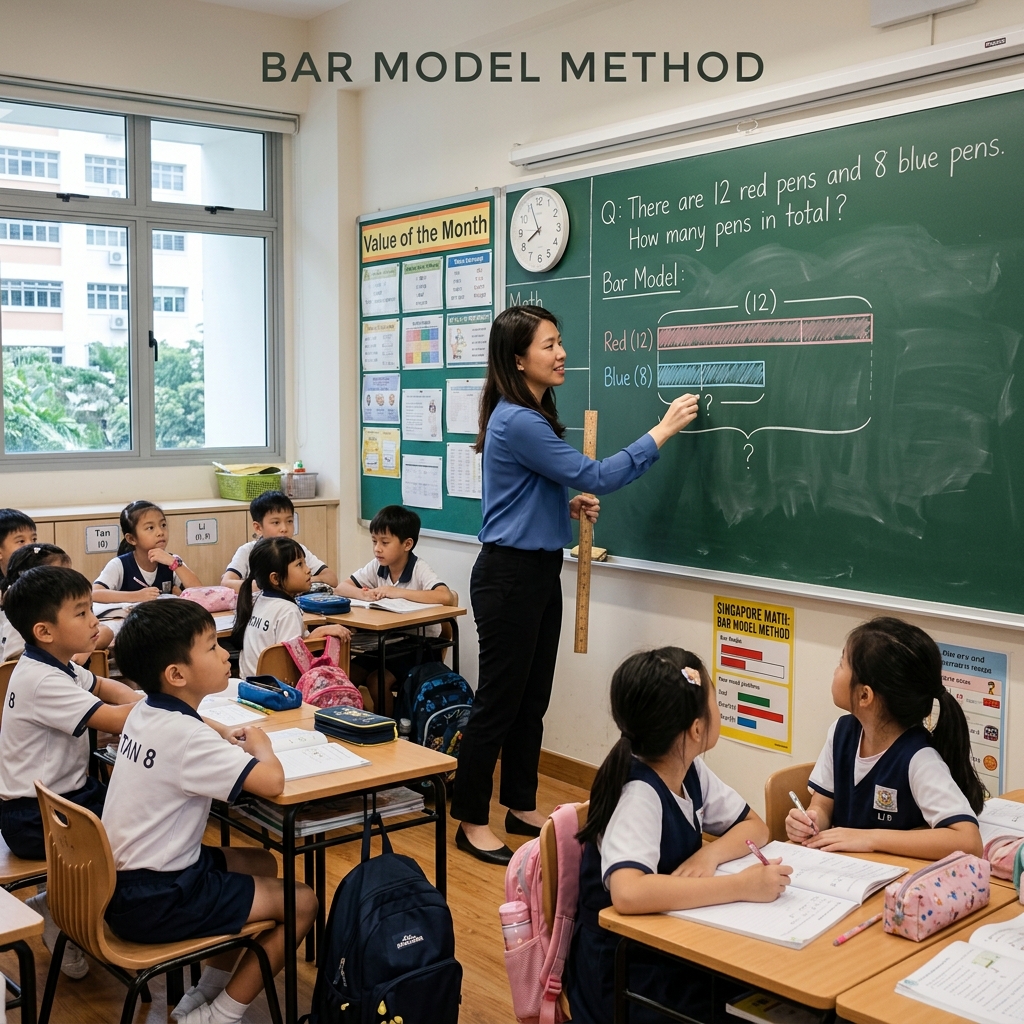
If your child has ever drawn rectangular bars to solve a word problem, they have used one part of the Model Method. But the Model Method is broader than bar drawing alone—it is Singapore Math's structured approach to turning abstract word problems into visual diagrams that reveal the relationship between quantities.
The Model Method is grounded in the Concrete-Pictorial-Abstract (CPA) approach, developed by American psychologist Jerome Bruner and adopted by Singapore's Ministry of Education. CPA teaches students to:
- ▸Concrete: Handle physical objects (counters, blocks)
- ▸Pictorial: Draw pictures or models to represent the objects
- ▸Abstract: Write number sentences and equations
The Model Method lives in the Pictorial stage. It is the bridge that allows primary school students to solve complex word problems before they have learned algebraic notation.
Bar Models vs. the Model Method: What's the Difference?
Many parents and resources use "Bar Model" and "Model Method" interchangeably. In practice, they are related but different:
| Concept | Scope | What It Includes |
|---|---|---|
| Bar Model | A specific drawing technique | Rectangular bars used for part-whole and comparison |
| Model Method | A complete visual problem-solving framework | Bar models, branching models, stacking/unit models, and more |
The Bar Model is the most common tool within the Model Method, especially in P3-P4. As students progress to P5-P6, they encounter problems that require additional model types.
For a detailed walkthrough of bar models specifically, see our Bar Model Method guide.
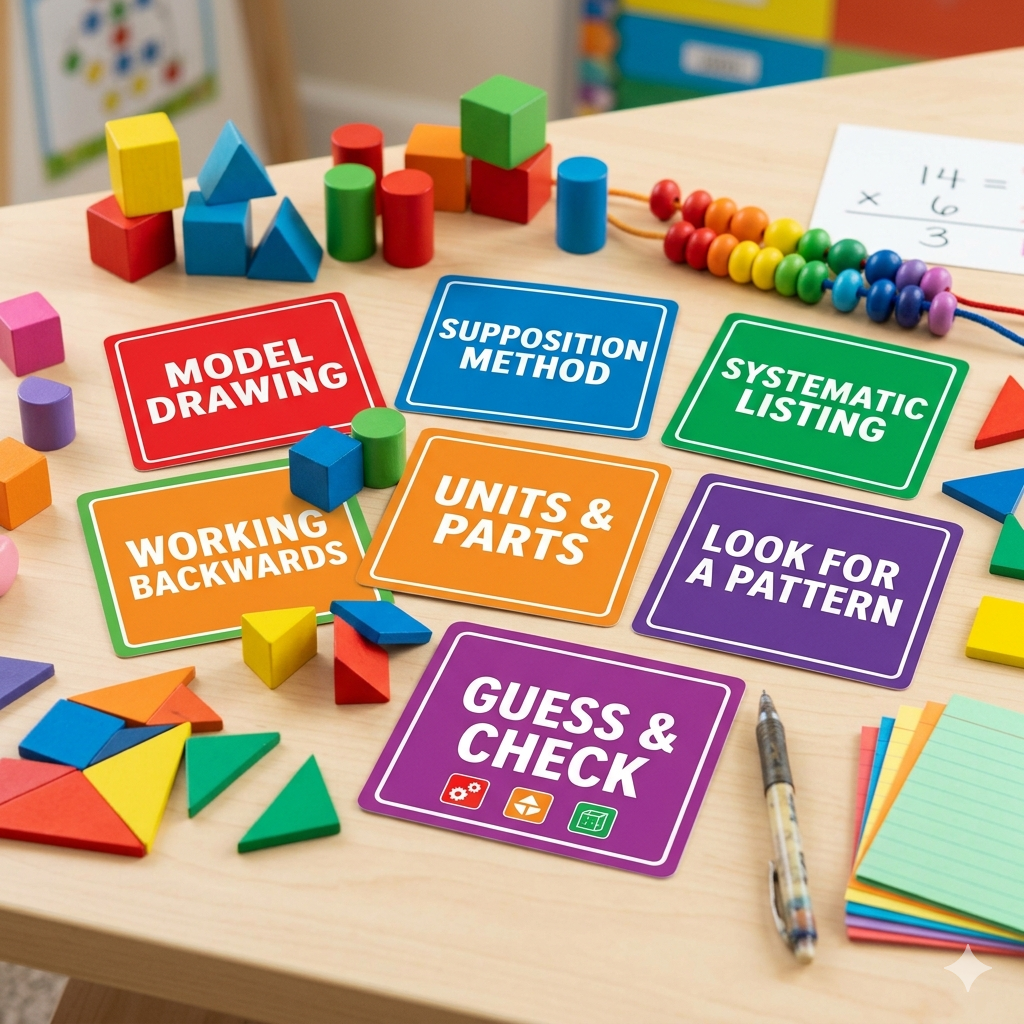
The Core Model Types
1. Part-Whole Models (P3-P4)
The simplest and most foundational model. A single bar represents the total, divided into segments representing each part.
When to use: The problem gives a total and one or more parts, asking for the missing part.
Example: A basket contains 48 apples and oranges. There are 29 apples. How many oranges are there?
Draw one bar split into two segments: 29 (apples) and ? (oranges). The total bracket reads 48. The answer is 48 − 29 = 19.
2. Comparison Models (P3-P5)
Two or more bars are drawn side by side (usually stacked vertically) to compare quantities.
When to use: Keywords like more than, less than, twice as many, as much as.
Example: Xavier has 3 times as many stickers as Yuki. Together they have 96 stickers. How many does Yuki have?
Draw Xavier's bar as 3 equal units and Yuki's bar as 1 equal unit. 4 units = 96, so 1 unit = 24. Yuki has 24 stickers.
3. Before-After / Transfer Models (P5-P6)
These track changes over time. The model has two states: before the change and after the change.
When to use: A quantity is transferred, given away, bought, sold, or otherwise changed, and the final relationship is given.
Example: Ali and Ben had the same amount of money. After Ali gave Ben $24, Ben had 5 times as much as Ali. How much did each have at first?
Draw the "After" state: Ali has 1 unit, Ben has 5 units. Since they started equal, the transfer must have been 2 units (halfway between 1 and 5). 2 units = $24, so 1 unit = $12. They each started with 3 units × $12 = $36.
4. Branching Models (P4-P6)
Branching (also called "tree diagrams") handles problems where a quantity is repeatedly divided.
When to use: Fraction-of-remainder problems ("He spent 25 of his money on a book and 13 of the remainder on a pen..."). Also probability and combination problems.
Example: A farmer sold 38 of his eggs on Monday and 25 of the remainder on Tuesday. He had 90 eggs left. How many eggs did he have at first?
Draw the total as a bar, branch it into two parts: Sold (38) and Remainder (58). Then branch the Remainder further: Sold Tuesday (25 of remainder = 25 × 58 = 28) and Left (35 of remainder = 35 × 58 = 38). The "Left" portion is 38 of the total = 90 eggs. So 18 = 30, and total = 8 × 30 = 240.
Branching makes these multi-step "fraction of remainder" problems manageable without algebra.
5. Stacking / Unit Models (P5-P6)
Also called "Units and Parts," this method uses two separate sets of units to represent two different ratios.
When to use: Problems involving two ratios, or ratios where one quantity changes while another stays the same.
Example: The ratio of boys to girls in a hall was 3:5. After 12 boys left, the ratio became 1:2. How many children were there at first?
Before: Boys = 3 units, Girls = 5 units (ratio 3:5). After: Boys = 1 part, Girls = 2 parts (ratio 1:2). Since the number of girls did not change, 5 units = 2 parts. Scale the "After" ratio so girls match: Boys = 2.5 units, Girls = 5 units. Now compare boys: 3 units − 2.5 units = 0.5 units = 12 boys left. So 1 unit = 24. Initially: 3 + 5 = 8 units × 24 = 192 children.
How to Choose the Right Model
A common question from parents is: "How do I know which model to use?" Here is a decision framework:
| If the problem involves... | Use... |
|---|---|
| A total split into parts | Part-Whole Model |
| Comparing "more than" or "less than" | Comparison Model |
| A transfer that changes quantities | Before-After Model |
| "Fraction of a remainder" | Branching Model |
| Two different ratios for the same items | Stacking / Units and Parts |
| Simple sharing or grouping | Part-Whole or Comparison |
In PSLE, many questions require combining two model types. A common pattern is: use a Before-After Model to establish the initial state, then Units and Parts to find the actual values.
Model Method vs. Algebra: The Transition
The Model Method is not meant to replace algebra—it is meant to prepare students for it. Every model type maps directly to an algebraic concept:
| Model Type | Algebraic Equivalent |
|---|---|
| Part-Whole | a + b = c |
| Comparison | a = b + k or a = nb |
| Before-After | a − x = n(b + x) |
| Branching | a = b × c/d × e/f... |
| Stacking | Simultaneous equations |
When students enter Secondary 1, they do not abandon the Model Method—they abstract it. A student who truly understands why the Before-After model works will grasp algebraic equations faster, because they have already internalized the relationship between quantities. The model was the scaffold; algebra is the structure.
Three Common Mistakes Parents Make
Mistake 1: Jumping straight to numbers
Parents often write equations before drawing. This defeats the purpose. The model should come first—it reveals the relationship. Numbers are filled in only after the model is complete.
Mistake 2: Using bars for everything
Bar models work well for addition, subtraction, and simple multiplication. For fraction-of-remainder problems or complex ratio changes, branching or stacking models are often clearer. If your child is struggling with bars for a given problem, try a different model type.
Mistake 3: Abandoning models too early
Some parents push algebra in P5 or P6 thinking it will be faster. For most students, the visual model prevents the careless errors that come with abstract algebraic manipulation. The model is not a crutch—it is a clarity tool. Let the child decide when they are ready to transition.
A Parent's Guide to Teaching the Model Method
If you are helping your child learn the Model Method at home, this sequence works well:
- ▸
Let them draw first. Before any calculation, have the child sketch the model. The model should represent the relationship, not the numbers. Numbers are added only after the model is complete.
- ▸
Do not correct the model immediately. Let the child complete the drawing, then ask: "Does this model match what the problem describes?" Self-correction builds deeper understanding than being told the answer.
- ▸
Introduce one model type at a time. Start with Part-Whole for P3-P4, add Comparison and Before-After for P4-P5, and introduce Branching and Stacking models for P5-P6. Each model builds on the previous one.
- ▸
Connect the model to algebra for older students. For P6 students who are ready, show how the same problem can be solved using algebra. This prepares them for the Sec 1 transition without abandoning the visual scaffold.
The Model Method is not a shortcut — it is a thinking tool. A child who can draw and explain the model has truly understood the problem. Focus on the drawing and the reasoning, and the calculation becomes straightforward.
Related guides: How to Solve Bar Model Method Step-by-Step → | PSLE Paper 2 Ratio & Fraction Models → | PSLE Math Hard Questions: How to Master Them →
Loading comments...
Practice & Tools
Share this article